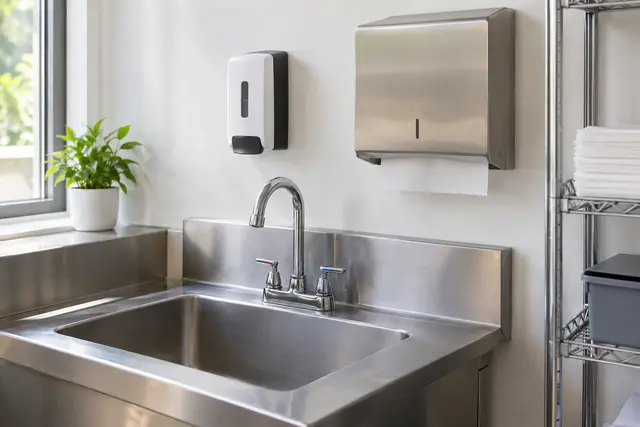
How do colds and flu spread at work?
Mainly through respiratory droplets and smaller particles breathed out when someone coughs, sneezes or talks, and through hands that pick a virus up from a door handle or a till screen and then touch the face. Influenza and the viruses behind a common cold both travel this way.
A kitchen pass, a nursery room and a care home lounge all keep people within a metre of each other for hours at a time. That is why one case so often becomes five by the end of the week.
When should someone stay off work with a cold or flu?
There is no single legal rule for respiratory illness outside food handling. UKHSA advice is to stay at home and avoid contact with other people if you have symptoms of a respiratory infection and either a high temperature or you feel too unwell to do your normal activities, returning once you feel better and have no fever.
Employers still owe a general duty under the Health and Safety at Work etc. Act 1974 to protect the health of staff so far as is reasonably practicable, and in care settings the risk to residents changes the calculation entirely. Food businesses are a separate case, and the rules there are firmer.
What does food hygiene law say about working while ill?
Assimilated Regulation (EC) 852/2004, Annex II, Chapter VIII requires any person suffering from, or carrying, a disease likely to be transmitted through food, and anyone with infected wounds, skin infections, sores or diarrhoea, to report it to the food business operator. They must not handle food or enter any food handling area where there is a likelihood of contamination.
Food Standards Agency guidance sets the practical line for vomiting or diarrhoea at 48 hours symptom-free before a return to food handling. A head cold with no gut symptoms is not an automatic exclusion, though a manager can move someone away from open food. The duty to report a reportable illness, meaning vomiting, diarrhoea, infected wounds or a disease that can be passed on through food, sits with the member of staff.
What actually reduces spread on a shift?
Washing hands with soap and warm water at the moments that matter, covering coughs and sneezes with a tissue or the inner elbow, binning tissues straight away rather than pocketing them, cleaning the touch points many people share, and letting fresh air into rooms where staff work close together.
Alcohol gel is useful between washes and no substitute for one, particularly on visibly soiled hands. Hand hygiene is also the control most likely to slip when a service gets busy, which is why the handwashing course covers technique in its own right.
Which surfaces are worth cleaning most often?
The ones many hands touch and few people think to clean. Door handles, light switches, taps, till screens, telephones, fridge doors, kettle handles and shared pens all qualify. Influenza viruses can survive on hard surfaces for hours, so a scheduled wipe-down of touch points beats a deep clean of the floor.
Disinfectants need their stated contact time to work. Spraying and immediately wiping dry gives you a clean-looking surface and not much else.
Who should take cold and flu prevention training?
Anyone working shoulder to shoulder indoors, and every supervisor who has to make the fit-to-work call at 6am with a short rota. Nurseries, care homes, kitchens and shop floors carry both the transmission risk and the absence cost.
The course is self-paced and ends with a CPD accredited certificate. It sits alongside infection control and personal hygiene and presentation in the library, all covered by the single £35 payment that gives one person 12 months of access to 130+ courses.